LadyKflo

LadyKflo

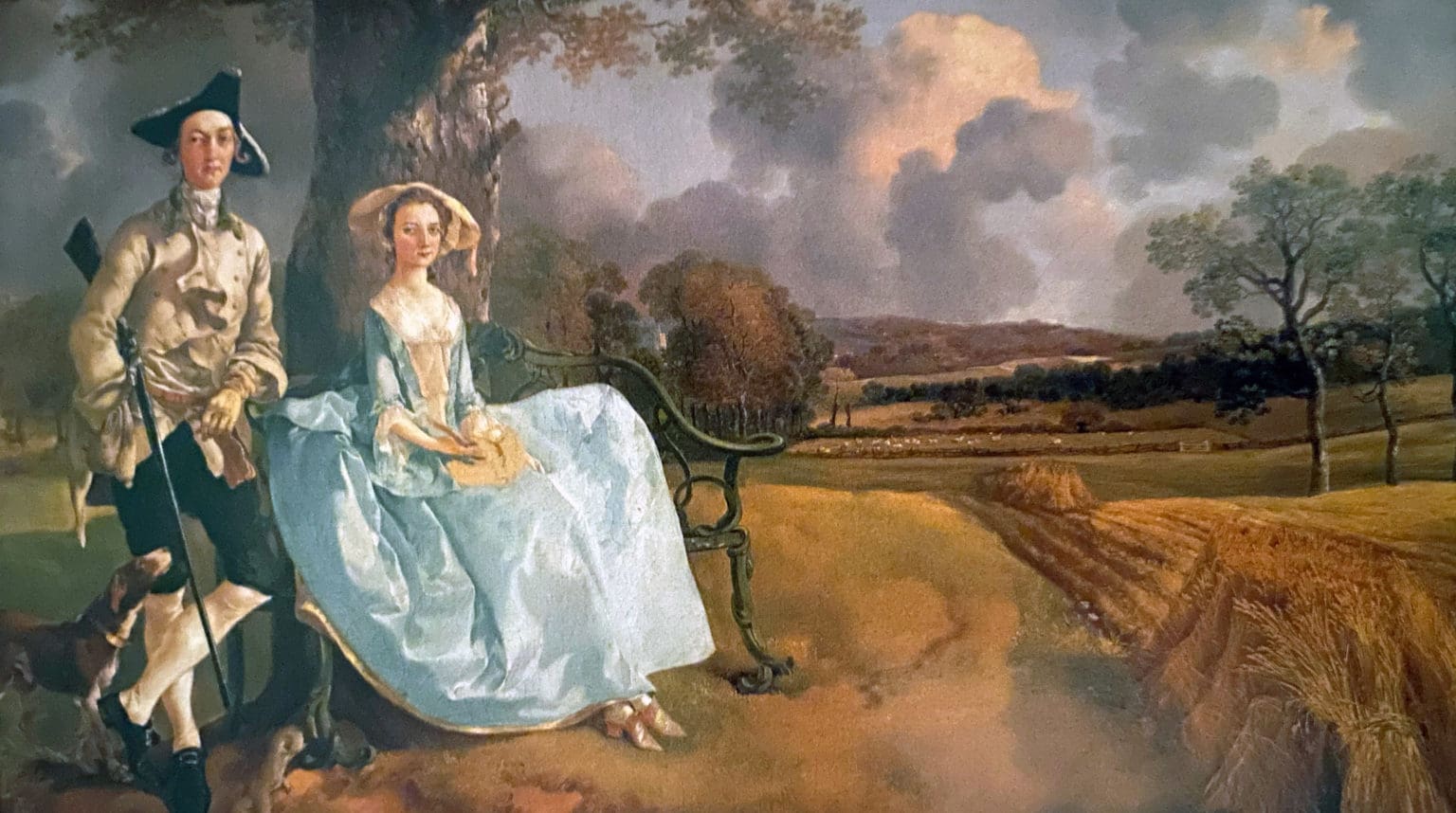
Mr and Mrs Andrews by Thomas Gainsborough, 1749

Masterpieces

Mr and Mrs Andrews by Thomas Gainsborough, 1749

Some couples seem made for each other, like Mr and Mrs Andrews in their 1749 wedding portrait. In this Thomas Gainsborough masterpiece we find these newlyweds proudly perched before their grand estate. Robert Andrews and his wife Frances Mary look so well-matched they could be siblings. Their setting is as suitable to them as they are to each other. It’s both rich and natural just like the couple. Robert and Frances Mary Andrews wear fine clothes with casual ease – unbuttoned and comfortable. Even with her ridiculous skirt, Mary seems nestled in the grandiose silk of it like a satisfied mother hen.


Podcast version of this post.


The Perfect Couple

Robert holds himself in the nonchalant manner of legacy aristocracy. I love his askew hat. During the 1700s these tricorn hats were called “cocked hats”. Robert’s hat echoes the triangular stance of his darkly clad thighs and shoes. Triangles are a symbol of stability, which points to Robert’s status and money. He can afford to cock his hat to the side, with such secure footing in the world. We also see a similar connection in the silk of his shirt with Mary’s hat, bodice, and shoes.

The couple hold their arms gently bent. They both cross their legs at the ankles. This is a perfect match. Even their eyes glance to our left in the same way. Their small dog gazes up at them from the left with adoration as well. This side of the painting works as a frame for the duo along with the tremendous oak at their backs. Other marriage portraits of the day highlighted constructed settings, like a castle, and often featured an arranged mismatched marriage. The parallel postures and position of this duo show how they belong in this natural world which became a theme of the time.

This particular spot shows where the park on their property meets the farmland and fields with crops and grazing animals. Mr and Mrs Andrews crown this estate with pride as if to sweep an arm across the landscape and establish their prominent position.


The Landscape Setting

The landscape dominates the canvas even though Mr and Mrs Andrews are the obvious owners of all they survey. There’s a contrast between their powerful positioning and the way they’re offset to the corner. This points to how significant land ownership was in the 18th century. The Andrews wanted to show off their land. But it was also a time when the bucolic escape of nature called to people and thus landscapes were popular subject matter for artists. Gainsborough devotes most of the canvas to the land, although the couple are a major focal point. That’s why this masterpiece works as both a portrait and landscape.

If you look deeper into the canvas you’ll find two churches, sheep, and plentiful crops. In fact, the couple married at the church we see tucked between trees at the heart of the portrait. This painting gives us a whole world with these two at the helm. They play a role in every part of it. The right side of the canvas encompasses the land that Frances Mary brought into the marriage while the left includes the small plot Robert contributed. In the middle we see the church where the couple married. This setting gives us a glimpse into the marriage just as the couple themselves do.

The Fresh Charm of Mr and Mrs Andrews

This masterpiece has become one of the most beloved British paintings. How? It’s the couple’s undeniable charm. Many portraits include frozen smiles or studied poses, especially in the 1700s. But Mr and Mrs Andrews have genuine facial expressions. They’re even a bit cheeky. I especially love the way Frances Mary gives Robert the side-eye. It’s an engaging reminder that couples need a bit of sass to keep relationships fresh and fun. These two seem like they know how to have a good time. The voluminous stiffness of her dress engulfs Frances Mary’s bench. But we can tell from her face that Frances can loosen up and may even be a bit of a firecracker.


Mr and Mrs Andrews – FAQs

Why is Mr and Mrs Andrews by Thomas Gainsborough an important painting?

When Gainsborough painted this classic artwork it was an experiment. He loved to paint landscapes but portraits were the order of the day. So, this painting was his way of combining the two genres. Gainsborough considered it a failed attempt. He left the painting unfinished and handed it off to the Andrews family. That was in the mid 1700s. Then in the 20th century the painting resurfaced and became an acclaimed icon of its time.

Mr and Mrs Andrews
made its exhibit premiere in 1927 and then the National Gallery in London bought it in 1960. The piece is now considered one of their most famous and popular paintings. It’s beloved for the fresh and charming way the subject matter presents the typical social practices of the time it epitomizes.

How is Mr and Mrs Andrews unfinished?

If you look closely at Mrs Andrews’ silk lap, there’s a mysterious beige blob. Art historians love to speculate about what Gainsborough planned for this spot and why he abandoned it. Gossip points to drama between the painter and the Andrews. After all, he left it unfinished. But it’s also possible that they wanted to hold this spot for a baby that would come later and then got too busy for the follow through on that plan. Many viewers of this beloved painting don’t even notice the mystery blob. They’re too caught up in the charm and wonder of this masterpiece.


Enjoyed this analysis of Mr and Mrs Andrews by Thomas Gainsborough?

Check out these other LadyKflo essays on British painters.


Sources

Check out Mr and Mrs Andrews at the National Gallery London

Alexander, Julia Marciari in: Warner, Malcolm and Alexander, Julia Marciari, This Other Eden, British Paintings from the Paul Mellon Collection at Yale, Yale Center for British Art/Art Exhibitions Australia, 1998

Graham-Dixon, Andrew A History of British Art, 1999, University of California Press

Langmuir, Erica, The National Gallery companion guide, 1997 revised edition, National Gallery, London

Jones, Jonathan, “Thomas Gainsborough: A Modern Genius”, The Guardian, 19 October 2002

Egerton, Judy, National Gallery Catalogues (new series): The British School, 1998
Marriage a la Mode II, The Tete a Tete by William Hogarth

Masterpieces

Marriage a la Mode II, The Tete a Tete by William Hogarth

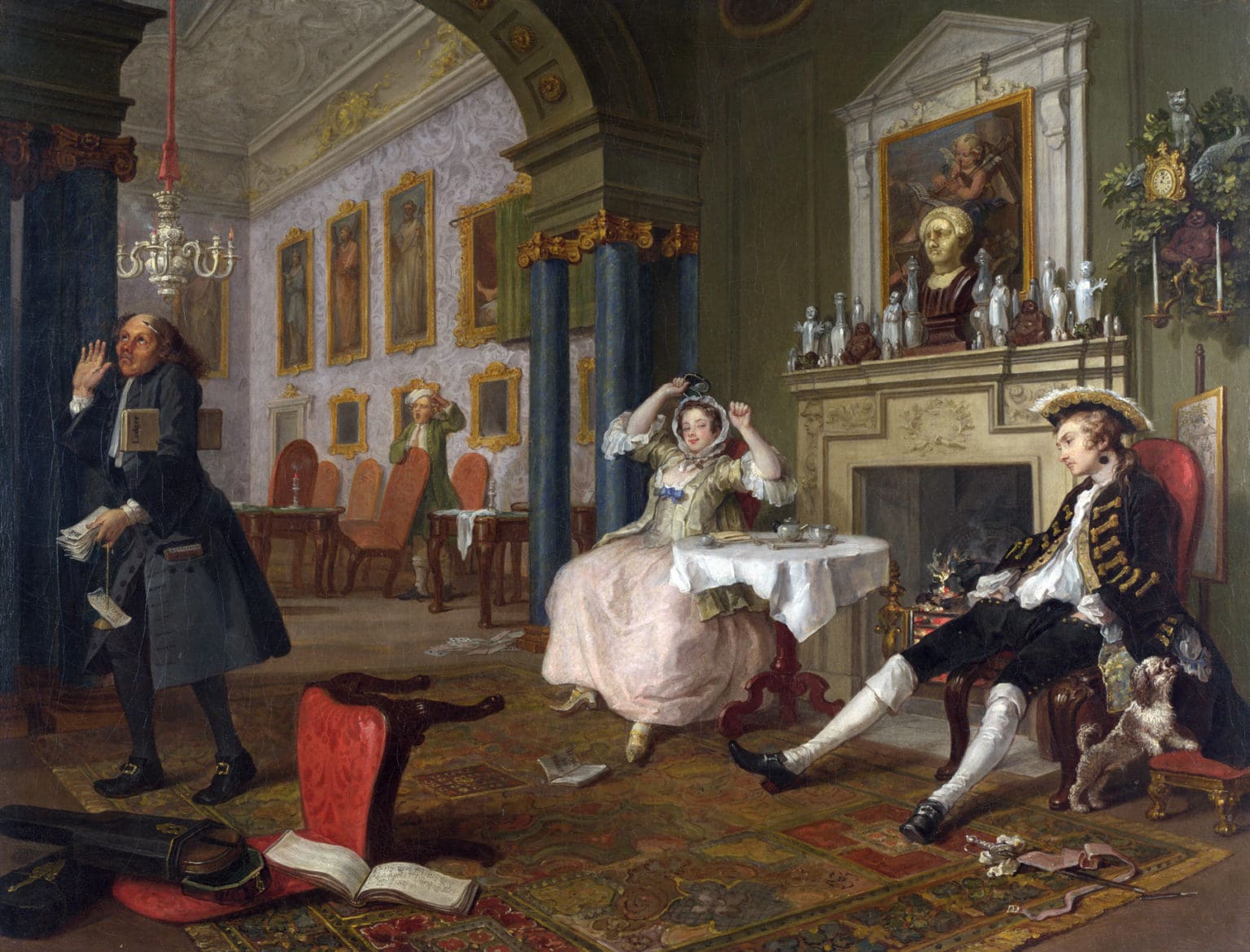
Marriage a la Mode II: The Tete a Tete works like a meme rather than just a painting. That’s because William Hogarth was more than a mere master painter. He was a writer and satirist with an unabashed bawdiness and humor that made Hogarth an icon. In fact, his work punctuated a significant part of the social milieu to the point that “Hogarthian” refers to art done in his satirical style even today.


Podcast version of this post.


French & Italian Art Influences

Evident from its title, Marriage a la Mode II: The Tete a Tete plays the second part in a series. This painting exemplifies the social culture of England in the mid 1700s -Hogarth’s time. It’s also a perfect example of how French and Italian painting influenced Great Britain with its subject matter and style. Hogarth painted with fresh and free brushwork in a hearty nod to the French artists of his day. He used this style with such distinctive flair that many consider Hogarth the most iconic artist of his generation in England.

We see the Italianate influence in the way Hogarth filled the walls of the scene with Italian paintings. These were beloved by the British upper class. But the other artworks littering the setting, such as the Rococo clock and porcelain figures from China, tell a different story. They represent shallow and silly showboating. Hogarth saw these types of objects as heartless and working against nature. He looked down on such bourgeois affectations and used them to help tell the story of the ridiculous duo in Marriage a la Mode II: The Tete a Tete. This was a key piece in his morality series about marriage and stands out as his masterpiece among many popular and salient artworks.


Hogarth’s Humor and Morality

The six paintings in Hogarth’s series Marriage a la Mode serve as a satirical indictment of society marriages in the 18th century. The painter held secular and rather unfashionable opinions at the time. High class marriages of the 1700s were often set up to suit societal positions and security rather than love. This wasn’t just common; it was expected. Hogarth found the predominance of this practice ridiculous. We see that throughout the series but with crystal clarity in Marriage a la Mode II: The Tete a Tete.

In this second canvas Hogarth portrays a mismatched marriage to comic effect. But there’s also a sickly element to the setting. The topic of marrying for money or convenience was buzzworthy in 18th century England. People were talking and writing about this because upper class society ran rampant with monetarily-based marriages.

Hogarth captured the drama, highlights, and humor of these unromantic couplings with a keen eye for detail. At heart, he was a master storyteller. Even though Marriage a la Mode conveys a tragedy in six parts, it takes us on a roller coaster of emotions. The way Hogarth makes us laugh and snort with disdain along the way gives the heartbreaking ending to the series an even more powerful impact. The story in six parts starts with the signing of the marital contract and ends with three of the main characters dead.

The second canvas, Marriage a la Mode II: The Tete a Tete earmarks the most amusing part of this story. Hogarth spotlights the inherent mismatch of the marriage with this chapter. A tête-à-tête refers to an intimate conversation between two people. So, the title points to how this scene should be private. Hogarth gives us a peek behind society’s curtain into the secret world of a miserable, mismatched, marriage.

Money Matters in Marriage

Trappings of superficial, gaudy appetites surround the couple. For Hogarth, these items represent the artificiality inherent to this marriage of convenience. No matter how pricey, knick knacks can’t fill the void between this unhappy duo. In fact, their facial expressions show opposite emotional states. She seems smug and flighty with her arms upraised. He’s withdrawn with a sad resignation. The tiny dog pulls a lady’s cap out of his pocket to show us that he’s already engaged in an affair. Standards of the time also point to his wife’s infidelity due to her casual posture and loose hair.

These were obvious signs of cheating at the time, though they seem subtle now. But the rest of the story reads as clear today as it did in 1743 when Hogarth painted this. The overturned chair, distressed help, and haphazard cloths and papers strewn about the scene characterize a disaster. I also love the way Hogarth sets the couple apart from each other; limbs akimbo and fine attire rumpled. They’re a mess that money can’t fix. That’s Hogarth’s message.

Marriage a la Mode II: The Tete a Tete conveys the lack of love with an amusing frivolity. Still, Hogarth gives us such a fully realized story that we get a holistic picture with greater depths than a mere joke. After all, marriage is serious business. That’s especially true when it’s based on finances and social status. We can feel this undercurrent in The Tete a Tete with the palpable tension and overwhelming clutter. It’s as if a storm brews underneath the fancy feet and lavish carpets of this divergent pair. Their demise feels inevitable… and we’re only on chapter two.


Marriage a la Mode II: The Tete a Tete – FAQs

What happens in the Marriage a la Mode series by William Hogarth?

Hogarth’s six part morality painting series Marriage a la Mode tells the story of a mismatched society marriage from beginning to end. William Hogarth combined satirical skill, refined French style, and a secular point of view to create these popular artworks.

The first canvas depicts the contractual union of an arranged marriage. We see a narcissistic groom, a weeping bride, and a monetary agreement between their fathers.

In the second piece, Marriage a la Mode II: The Tete a Tete we find the couple cranky and distant, their home in disarray. They didn’t take to each other. Hogarth already hints at adultery.

The third painting gets much darker in tone. We see the husband visiting a doctor for syphilis along with a woman (not his wife) and child also suffering from the disease.

Chapter four shows an inheritance of power for the couple. Due to his father’s death, the husband is now an Earl and the wife a Countess. We also see more signs of adultery and estrangement between them.

The fifth piece raises the stakes. The wife’s lover has killed the Earl, who apparently caught them in the act.

In the sixth and final chapter, Hogarth concludes the tragedy. The wife’s lover has been executed for murdering her husband and she has taken poison and died.

Why was William Hogarth an important painter?

A writer, painter, and cartoonist, William Hogarth was an iconic artist that defined 18th century English art. He had a distinctive, bawdy style that’s recognized today as ‘Hogarthian” in satirical cartoons.

His paintings told rich and moralistic stories that often mocked the elite class of Britain. For instance, Hogarth believed that marriage worked best with a foundation of love and natural connection. He thus painted Marriage a la Mode, a series of six pieces skewering the arranged, loveless, marriages of the moneyed class.


Enjoyed this analysis of

Marriage a la Mode II: Tete a Tete?

Check out LadyKflo’s essays about other National Gallery London paintings.


Sources

Cynthia Ellen Roman, ed., Hogarth’s Legacy (New Haven and London: Yale University Press, 2016)

Quennell, Peter. “Hogarth’s Election Series.” History Today (Apr 1953)

Elizabeth Einberg, William Hogarth: A Complete Catalogue of the Paintings (New Haven and London, Yale University Press for Paul Mellon Centre for Studies in British Art, 2016)

See the whole series Marriage a la Mode at the National Gallery London online

Bomford, David and Roy, Ashok “Hogarth’s ‘Marriage à la Mode'” Technical Bulletin Volume 6, 1982 National Gallery

Elizabeth Einberg, Hogarth the Painter (London: Tate Gallery, 1997)

Bernd W. Krysmanski, Hogarth’s Hidden Parts: Satiric Allusion, Erotic Wit, Blasphemous Bawdiness and Dark Humour in Eighteenth-Century English Art (Hildesheim, Zurich, New York: Olms-Verlag, 201

The Other Hogarth, eds. Bernadette Fort and Angela Rosenthal, Princeton: Princeton University Press, 2001.